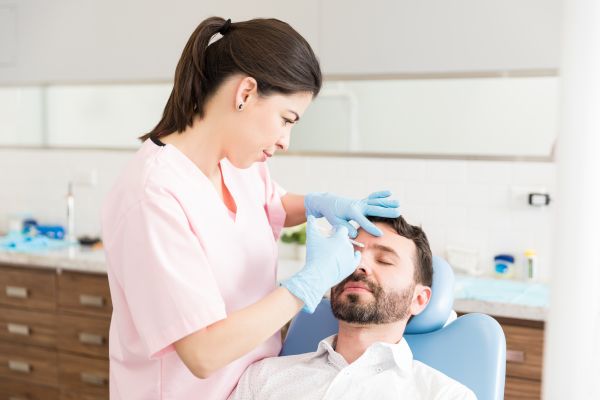
Botox® for TMJ might be recommended if a dentist determines you have problems with your temporomandibular joints that are being caused by overactive muscles or if other treatments have failed. A TMJ disorder is a problem that affects the temporomandibular joints. These are the joints that connect the lower jaw to the rest of your face. They allow you to open and close your mouth and move your lower jaw from side to side. These joints can become damaged for various reasons, like undue stress being placed on them due to bite imbalances, trauma to the face, or habits like teeth grinding.
Treating issues with the temporomandibular joints with Botox does not provide a permanent solution for TMJ issues, but it can help to alleviate some of its symptoms and effects like:
- Headaches due to grinding teeth
- Tension in the jaw
- A locked jaw
How Botox for TMJ works
Botox is a neurotoxin protein that is used to paralyze muscles temporarily. It is mainly known as a way to reduce signs of aging like wrinkles, but it does have therapeutic uses as well. It can be used to temporarily paralyze overactive muscles in the jaw, reducing the symptoms of TMJ disorders.
The procedure
Botox for TMJ treatment is performed as an outpatient procedure. These treatments typically take anywhere between 10 to 30 minutes. It often involves patients getting three or more injections in a span of several months.
During the treatment, the dentist might inject Botox into the patient’s jaw muscles, temple, and forehead. Other areas around the jaw might also be targeted based on the patient’s symptoms. A topical anesthetic might be used during the procedure to minimize the pain felt from the injections.
There is no significant recovery period after getting Botox injections, and patients can return to their regular activities after the treatment. People who get Botox treatments should refrain from touching or rubbing the injection site for the first few hours after their treatment. This can lead to the neurotoxin spreading to other muscles in the area, paralyzing them. It often takes about a week before patients begin to get noticeable relief from their symptoms.
Other options
Botox treatments are one of the options patients get to choose from when it comes to addressing TMJ issues. Other ways to deal with TMJ issues include:
- Physical therapy: Milder TMJ disorders can be treated with exercises that strengthen and stretch muscles in the jaw. Aids like hot and cold compresses are also used as a part of physical therapy for TMJ
- Arthrocentesis: This involves inserting tiny needles into the temporomandibular joints to drain fluids and other debris in them
- Arthroscopy: This is a surgical procedure performed with a cannula inserted into the TMJ. An arthroscope is inserted into the cannula to perform the treatment
Explore Botox for TMJ
Looking for fast relief from the symptoms of TMJ? Give us a call or stop by our Belleville clinic to set up an appointment with our dentist.
Request an appointment here: https://www.keepsmilingdentalpc.com or call Keep Smiling Dental PC at (908) 854-3266 for an appointment in our Belleville office.
Check out what others are saying about our dental services on Yelp: Botox in Belleville, NJ.
Related Posts
Bruxism, also called teeth grinding, can cause significant teeth damage, lead to concerns such as TMD disorder and make it difficult to sleep each night, but fortunately, Dental Botox® offers a solution to treat bruxism for many patients. It is helpful to learn more about dental Botox in order to decide if it is an…
Some dentists offer Botox® for TMJ symptom relief. Although it is not yet approved by the U.S. Food and Drug Administration (FDA), the results in studies thus far have been very promising, with many patients reporting symptom relief for their TMJ in as little as just a few days. As is the case with any treatment,…
The application of dental Botox® for the treatment of oral health issues is becoming popular in different fields of dentistry. Cosmetic dentists use dental Botox® to correct a gummy smile or to minimize the look of wrinkles around the mouth. On the flip side, general dentists use Botox® to treat disorders like teeth grinding and…
For years, Botox® has been a method to treat various health conditions and wellness issues. People have looked to this treatment to smooth wrinkles and other blemishes of the face. This drug is a toxin made from a specific bacterium, and it has many other uses today. You may even find that it is useful…